Showing posts with label Red Kites. Show all posts

Sunday, 6 July 2014

Changing years & Changing fortunes

In the relatively short time I have been photographing wildlife, I have seen many changes particularly in the changing fortunes of the wildlife – I don’t think many of us think about the animals around us and their daily struggle for survival and our impact on them.

With every new year, as well as looking for new places interest, I have a dozen or so locations of which I have regularly visited and it is at these areas I find that rarely is one year the same as the previous in what I will see.  The reasons no doubt vary – changing habitat, disturbance, disease, seasonal changes in the weather or just a natural changing balance of nature.  From a photographic point of view it means no guarantees on what I can shoot on a yearly basis and so take advantage of any unusual influx or increased population of an animal.

The below choice is not exclusive or necessary typical nation wide, rather from my own experiences of the animals I have or would usually see or seek out.


GREEN-ARROW-UP

On the way up

Grey Squirrel

No more obvious of the changing fortunes is the Grey Squirrel.  Nine years ago when I started back into photography shooting wildlife, the Grey was in the process of finishing off taking over the Native Red Squirrel in this area.  The woods where I once used to watch the Reds chasing each other around the trees were now replaced by these foreign invaders and have grown in numbers.  Of all the mammals around this area this is the easiest to find and see.  So, although on the way up in numbers, it’s probably not the most popular success story by most.

IMG_04346
 

Red Kite

When I was growing up, the Red Kite was very rare.  My trusty old ‘Birds of Britain and Europe’ book had them living in only a small area of Wales.  Once very common, it was almost wiped out through persecution by the 20th century.  In 1989 around the Gateshead area of North East England it was reintroduced (as it was elsewhere in the country) with great success.  Now, in this area at least, it is the most seen bird of prey and one of my favourites and I never cease to be impressed with the sight and sound of this bird.  During the winter months they communally roost so you can see a dozen or more in any one area.

IMG_21226
 

The Buzzard

The Buzzard, like the Kite, was also persecuted but, unlike the Kite they survived and as laws have been brought in to give birds like this some protection, this bird of prey has managed to not only survive but become what is now the most common bird of prey in the UK.  As with the Kite, it was only a short time ago that I first saw one of these birds and it is also a sight to watch one gliding overhead.

IMG_14736


arrows_back_forward

No change

Roe Deer

At first I never saw one of these.  They would have been around but I didn’t have the knowledge or experience of finding them.  I’m sure during the nine year period I’m including in this post, the Roe Deer has probably increase in numbers but it’s not something I have particularly noticed.  Even if you don’t see one due to their timid nature, the signs are all around that they are here and again, an animal I just love to watch.

IMG_07306
 

Kingfisher

Purely from my experience of this bird over recent years I have it in this section though it could belong ‘Fluctuating’ below because it is very susceptible to a bad winter of which we have had a few, but their numbers seem to bounce back.  What I have found is that there doesn’t seem to be a yearly regular spot I can go to see them and even where I can, this will change on a month to month basis.  Perhaps my favourite birds to watch and photograph.

SMP_46945
 

Heron

Definitely a consistent regular.  Anywhere it seems where there is water there’s a Heron – Lakes, ponds, rivers or the coast, more than not you will see one.  A photogenic bird and one that will often conveniently keep still for you although it doesn’t like you getting to close to you.  It has it’s comfort zone and you can be very visible outside of that and it will ignore you, but step inside of it and off it goes.

IMG_07766


arrows_green_red (1)

Fluctuating

Fox

By fluctuating, I mean that these animals have been sighted by me in regular numbers for a while then gone through a lull then picked up again, though I’m sure this would be localised.  The Fox some six years ago, I was practically ‘tripping over’ them wherever I went.  There were places I could go were I would almost be guaranteed to see them and could do so in the middle of the day.  Then they were gone.  Since Fox hunting was rightly banned, it’s meant you can actually see this animal in daylight and is my favourite mammal to do so.  There is something about having one look right at you – almost wolf like with those eyes – and I’ve had numerous close encounters with them that has given me that special connection with nature, which reminds me why it is I like to spend so much time out in the wilds.

IMG_22836
 

Rabbit

I’m sure the Rabbits and Foxes lives are intertwined in their numbers.  Rabbits will go through periods where their numbers are very numerous then they will go into decline and alongside this, the number of Foxes will correspond with this since they prey upon them.  I think due to their ability to multiply however, Rabbits can gain their population much quicker.

IMG_32446
 

Sand Martin

I’ve seen Sand Martins every year but their numbers seem to vary on their ability to find suitable nesting areas and in recent years, at least the areas I visit, these have been fewer in number.  In the two most noticeable areas that I usually visit, the sand banks have either collapsed or more eroded making it easier for predators to get to the nests within the banks.

TBP_51926
 

Short Eared Owl

This is an owl that’s largely a winter visitor and their visiting numbers will greatly depend on the severity and type of the winter otherwise they will stay either further north or south.  Three to four years ago, they were found in large numbers a a number of locations, the past winter they were far fewer to be seen.  There numbers also depend on the prey around so a good year for voles and mice will help keep the numbers up.

SMP_34766


arrows_green_red

On the way down

Kestrel

When I was growing up the Kestrel was the most common bird of prey in the UK and one I would regularly see – the hovering Kestrel is a very distinctive sight, in fact, apart from an Osprey I saw on a family holiday in Scotland, I had seen no other bird of prey until many years later.  In the last year I’ve had four sightings of them, I previously could almost guarantee to see one when I went out, but not now.  Hopefully it’s not a permanent change of fortunes for the Kestrel as I’ve always enjoyed watching this bird hunt and it would be a great loss.

IMG_29576
 

Red Squirrel

As obvious as the Grey Squirrels rise in fortunes, so has been the Reds demise.  It didn’t seem that long ago that these idyllic little animals where the only squirrel around and very common.  Along with the Fox they have been my favourite animal to watch, with their pluckiness and curiosity you can’t help but love them and they are so much better looking than the Grey – their ultimate reason for their quickly vanishing from our woodlands.  Unfortunately, I haven’t seen one in two years and unlikely, at least in this area, that I'll see one again!  They still have a refuge further up in Northumberland and hope to spend some time later photographing them their before they disappear from there too.

IMG_32966
 

Puffin

Despite seeing them in as apparent large numbers as usual whenever I’ve visit the local Farne Islands, they are on the decrease, they say due to the seas warming and so the loss of their main diet of Sand Eels.  If this is the case, much like the two animals above, it would be a huge loss.  As with those two, the Puffin is a great animal to watch and like the Red Squirrel, seems to have it’s own special character.

392X0102


I’ve added two other animals under no particular grouping, the Otter and Sparrowhawk.  Technically both are supposed to be thriving though I rarely see either.  The Otter is a success story, once very rare due to the pollution of the rivers in this country, now that they are much cleaner they are now found all over the country, even in the local Tyne River, once extremely polluted due to the shipping industry.  Apparently they can be found under the city lights themselves, but being nocturnal, are seldom seen unless you’re lucky.

My typical sight of a Sparrowhawk is seeing shoot past in a wood as it chases its prey or I’ve disturbed it just after making its kill.  Their signs of a kill are common – just a load of feathers of a pigeon which it would have then taken off with.  To get a photograph of one is even rarer than seeing it due to living in the woodland and rarely keeping still or out in the open.

Again, this is just a few of the most noticeable animals in recent years and there are others such as Barn Owls which I haven’t seen for a while and woodpeckers both Green and Great Spotted which I see and hear more often.  I wonder what differences the next ten years will see.

IMG_22006
 
img_05112

Monday, 17 June 2013

Siggy’s back!

It’s been away for what seems an age, but finally my Sigma 500mm lens is back from the repairs and is as good as new thanks to the good people at Sigma.  So it was with great expectations that I went out at the weekend with it.

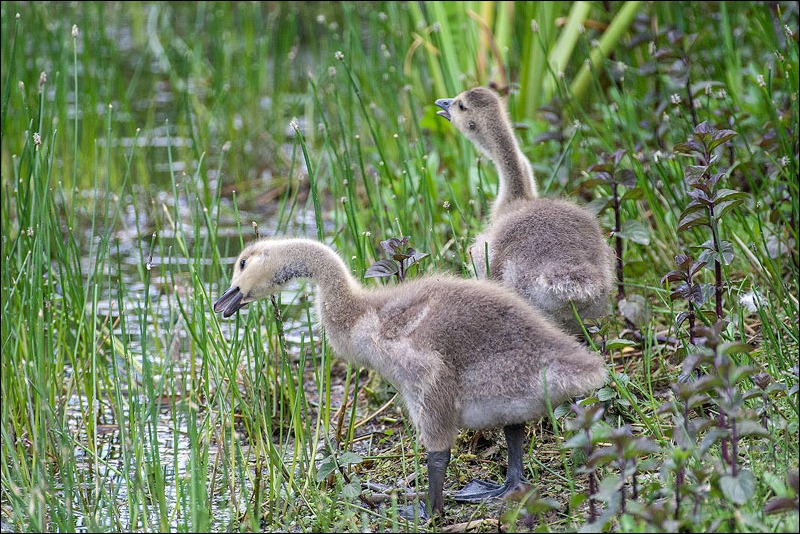
The main hope of the day was to photograph the local Red Kites but anything else was also game if I came across it and with that extra 100mm gain over what I had been using recently, more would be open to opportunity, especially small birds.  It was ironic then than for the whole morning I struggled to get close to much – maybe it was simply too higher expectation – but little was filling my cameras frame.  The Heron below moved away within a minute of my arrival, the Reed Buntings that had been so accommodating last week, this week didn’t keep still as was the case of a family of Long Tailed Tit fledglings I came across, Red Kites were also circling high up in the distance as was a lone Buzzard.  Only a family of Canada Geese gave me the chance to reacquaint myself with the magnification of a 500mm lens.

Heron, Sigma 500mm f4.5

A Heron deciding not to hang around for me

Coot, Sigma 500mm f4.5

Not every image has to be filled by the subject to make it work.  A Coot moving across a weed covered lake patterned by previous movements

Canada Goose chicks, Sigma 500mm f4.5

Despite the poor opportunities, I had used up most of a 2GB card when I saw a Red Kite coming low towards me and I had moments to get into an open position where the trees weren’t in the way, took one shot where my camera then refused to take anymore.  Reason? It was saying ‘card full’.  All I could do was watch the Kite glide over me.  By the time  I would have got a new one out, it would have been just in time to get the back end of the bird disappearing.  I new that card was nearly full but it should have automatically transferred to the second one, trouble was I hadn’t deleted the contents of it before hand as I thought I had and this one too was full.  The closest I have been to a wild Red Kite and I only managed to get one shot of – a poor one at that.  I was starting to think this was not going to be my day.

Red Kits, Sigma 500mm f4.5

One of the best places you can see Red Kites on Tyneside is the Nine Arches Viaduct along the Derwent Walk Country Park.  It’s a bit of a cross roads for them, often nesting nearby and a communal roost in winter not far away.  It was here I made my final stop of the day and waited in the hope that one might just come down close enough to give me a good view.

DSCN0552

Nine Arches Viaduct in the centre

Plenty of Kites could be seen (and heard) in the distance but none wanted to come close enough so I become distracted by a small ‘jumping spider’ patrolling right in front of me on the viaduct ledge.  A macro opportunity I thought so quickly changed lenses.  This spider wasn’t going to make it easy for me, it was constantly on the move and when it did stop it didn’t give me enough time to focus on it before it was off again.  I’m still getting used to macro.  This spider was tiny and the depth of field was a matter of millimetres and in keeping with typical wildlife photography where you always should focus on the eyes (in this case many eyes), was difficult, not helped by my having to stretch and the quite poor light – for macro at least.

I did notice it going over the viaduct edge every now and then, then reappearing and hoped I could catch it just poking up over the top with those beady eyes and the lovely green background.  Trouble was, I never new where exactly it would appear and when it did, it didn’t stop for long.  I did mange a few shots – not exactly what I wanted but ok.  I didn’t realise until I got them home and looked on the computer that it had caught something, a fly of some sought, and was carrying it off.  It’s amazing really.  Here I was with my newly returned long telephoto lens trying to capture distant images and drama and right under my nose, right were I was standing, drama in miniature was unfolding.

I continued to ‘stalk’ this diminutive predator as it hurried along but was distracted by someone asking me was that a camera I had!  I manage to resist the urge to sarcastically say, no it’s a Morphy Richards silver kettle and answered him, but now I had lost my spider.  Also funny, while I was pointing the lens over the top of the viaduct, photographing something that was only centimetres away, people were stopping and looking over the edge at something they thought I must be photographing in the distance!

Whilst trying to find the spider again, I noticed what I thought was a small, fluttering bird below which I then realised was in fact a bat!  It’s been a long time since I’ve seen a bat and never in the middle of the day.  There must be some of them living under the arches.

Jumping spider taken with a Sigma 105mm f2.8 lens

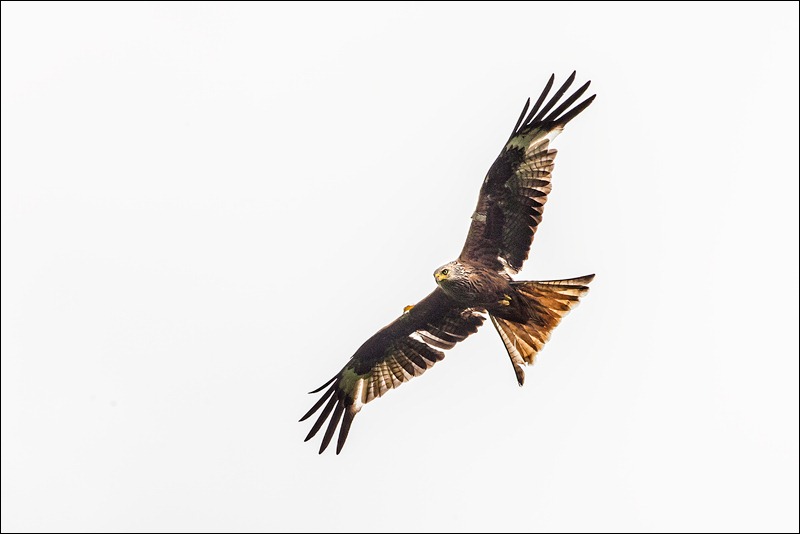
Whilst being distracted by the bat (and the spider) a Kite passed low overhead.  By the time I scrambled to get the 500mm lens back on, it was already some distance away and just as I thought I'd missed yet another opportunity, it turned and started an ascending, circling glide.  By the time it made its first passing I was able to dial in some exposure compensation so as not to get a silhouette and take some frames.  By the second passing I was also able to drop the ISO from the 1600 needed for the macro to 800.  Still, conditions were not ideal.  It was overcast, though reasonably bright with the position of the sun overhead and behind the Kite.  A combination of over compensation the exposure for the Kite and the grey, formless skies, meant for a ‘washed out’ look to the images, so unfortunately, they’re not great.  Still, I quite like the first showing the Swift in frame, one of many that were also flying around.

It was amazing how, after only a few minutes, this bird was far up in the sky and some distance away.  I don’t think I saw it once flap its wings but rather just used the natural, warm uplifts of air to effortlessly glide away.

I suppose I could work on the images on the computer to bring out what hazy blue colour there was in the sky to help improve the picture and maybe try this before uploading the few decent ones to my website.  I’m still waiting to get a really good, technically, Kite shot.  Maybe I’ll try again over the coming months.

Red Kits, Sigma 500mm f4.5
 

Raided Long Tailed Tit nest

Update from previous post about Long Tailed Tit nest.

Last week I did re visit the nest I’d been watching over a couple of weeks in hoping to see the chicks fledge.  Unfortunately I came across the scene in the photograph left.  It looked like a predator had got in the nest and presumably taken all the chicks.  Click on the images of a larger view.  You can see the nest in the background and feathers littering the foreground, presumably, lining from inside the nest.

Although the nest was low down, I had thought being in a thorny Gorse bush overlooking water, it was relatively safe.  It must have been a small mammal, maybe one of the weasel family.  A bird of prey such as a Sparrowhawk couldn’t have got in.

It’s a shame but then Long Tailed Tits do have a high mortality rate and their nests at this time of year are often raided like this.

Friday, 15 March 2013

Some Kites in Flight…and a Cormorant

I’ve been busy trying to improve on the look of my blog as I’ve been unhappy with the image size restrictions this particular template has, preferring to have larger viewed images than it allows.  No luck so far, so I may have to scrap this current look and start again.  Just to keep things ticking over in the mean time, I’ve got these images, though they don’t look very impressive so small, particularly the first Kite image and two Cormorant images which, despite the latter being an otherwise ‘boring, plain’ looking bird, with its feather detail actually looks quite impressive on the full size image.  I will be uploading these images to my website so they can be viewed in their full glory.

I didn’t realise when photographing the first Kite image, just how intently it was looking straight at me!  I have to admit, I do have a soft spot for birds of prey, but I particularly like just watching the local Red Kites.  There’s something special about just seeing them gliding effortlessly overhead occasionally making that piercing high pitched cry.  Although at this time of year they will be dispersing around the region from their wintering roosting, I hope to get out soon and get some more images of them.

I’m surprised that nobody in the North East has come up with the same kind of idea as Gigrin Farm in Wales and have a feeding station set up.  If anybody knows why, I would be curious to find out.

Red Kite
 
Red Kite
 
Red Kite
 
Red Kites
 
Red Kite
 
IMG_9290
 
IMG_9256

Monday, 19 November 2012

Best Laid Plans

At this time of the year, it can be a good time to see the local Red Kites as they make the most of the short days but also because of the communal roosts where they all gather in the evening.  I hadn’t tried to photography this spectacle before partly because I figured at dusk, at this time of year, the lighting would be too dark, but I thought I would at least be an event to watch.

I waited for a day that promised wall to wall sunshine and decided to make a day of it by taking in some of the other sites this part of the Derwent has to offer and where the Kites gather.  It can be a bit ‘hit and miss’ this section when it comes to wildlife – off the main track, an ex-railway line, nearly every person has a dog or two (or three, four, five) and the air is full of the sound of barking as dogs, off the lease going for other dogs (or people), so it’s not really conducive for wildlife.

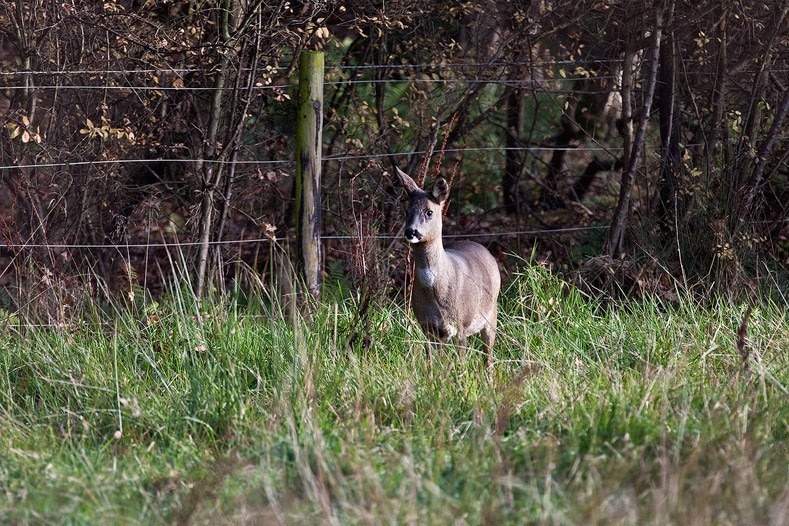
It was a bit of a surprise then that, in the middle of the day, whist walking off a side lane that I saw a couple of Roe Deer browsing on the outskirts of a wooded area next to a field.  Luckily I saw them first and ducked behind a wooden fence than ran along the road and field and was able to be hidden for the most part. 

SMP_6671

Expecting them to either pick up on me or be spooked by another passer by, I quickly got my camera and lens out and took some make shift photos, hand held and through the fence and long grass.  After these initial shots and as they settled, I had time to attached my monopod and take a bit more time over the images and move slightly to get a better vantage point.  Inevitably somebody came walking down the lane which got the deer's attention.  Soon another couple of people were walking up from the other direction and the Roe Deer disappeared back into the wood.

SMP_6683
 
SMP_6695
 
SMP_6698

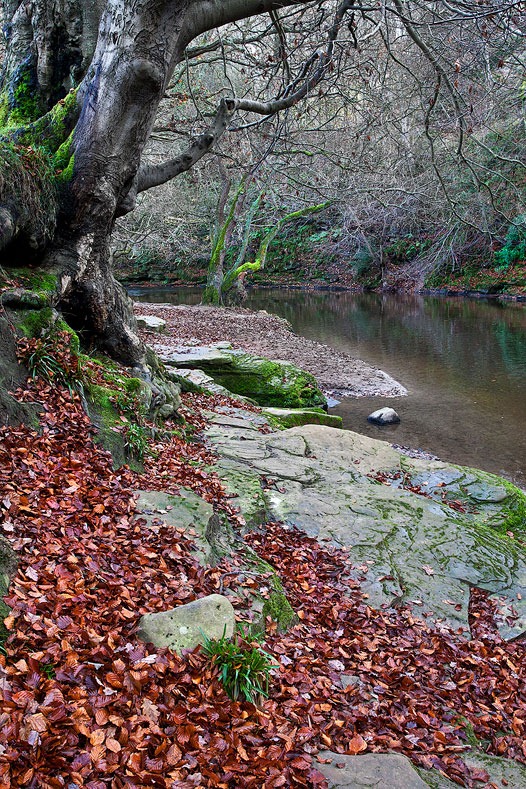
I decided to follow the river up to the viaduct which is were I was expecting the best vantage point to see the Kites.  Little else to be seen along this part.  A Dipper was flying backwards and forth, but always stopping in an area too dark to get a decent image.  Kingfishers are quite common here during the summer but by now they have moved to their winter areas further down stream.  Sometimes you see scenic image which you think might look good in print or converted to black and white.  The image below I thought might work either way, the contrasting colours of green mosses and reddish brown leaves with the bleak mono tones of trees and branches.  The black and white version didn’t work but I think the colour one’s ok.

SMP_6740
 
SMP_6759
 
SMP_6764

I arrived on site, and although only around three in the afternoon, it was already getting dull, partly because it was becoming overcast (so much for the all day sunshine promised). After about half and hour the first Kites started to arrive, flying past but too high to get a decent image.  I had hoped they would roost in the nearby trees, but instead were flying off and gathering on a pylon and a couple of trees off in the distance.

Too far away to get any worthwhile images and with the light fading fast, I decided just to watch.  Quite a few Kites ended up gathering on the various roosts.  I counted twelve on the pylon, another ten in or around a tree and another four dotted around – at least twenty-six.  Not bad for a bird that only a few years ago was all but extinct from the UK except for a few locations in Wales.  Thanks to their reintroduction they are becoming common in many areas.

It’s a shame that many birds of prey are persecuted – mostly out of ignorance and even now this magnificent bird is.  Amazingly even some dim witted locals believe that this bird can swoop down and take off with the darling little pooch!  Only a Golden Eagle would have the power to take dog and there’s not too many of them around!  The Kites diet is much the same of that of a Buzzard with the biggest animal preyed upon being a rabbit or hare or otherwise they feed a lot off carrion.

For more information on Red Kites in the North East of England see www.northernkites.org.uk/

 
SMP_6770
 
SMP_6777
 
SMP_6789