Showing posts with label Short Eared Owl. Show all posts

Sunday, 6 July 2014

Changing years & Changing fortunes

In the relatively short time I have been photographing wildlife, I have seen many changes particularly in the changing fortunes of the wildlife – I don’t think many of us think about the animals around us and their daily struggle for survival and our impact on them.

With every new year, as well as looking for new places interest, I have a dozen or so locations of which I have regularly visited and it is at these areas I find that rarely is one year the same as the previous in what I will see.  The reasons no doubt vary – changing habitat, disturbance, disease, seasonal changes in the weather or just a natural changing balance of nature.  From a photographic point of view it means no guarantees on what I can shoot on a yearly basis and so take advantage of any unusual influx or increased population of an animal.

The below choice is not exclusive or necessary typical nation wide, rather from my own experiences of the animals I have or would usually see or seek out.


GREEN-ARROW-UP

On the way up

Grey Squirrel

No more obvious of the changing fortunes is the Grey Squirrel.  Nine years ago when I started back into photography shooting wildlife, the Grey was in the process of finishing off taking over the Native Red Squirrel in this area.  The woods where I once used to watch the Reds chasing each other around the trees were now replaced by these foreign invaders and have grown in numbers.  Of all the mammals around this area this is the easiest to find and see.  So, although on the way up in numbers, it’s probably not the most popular success story by most.

IMG_04346
 

Red Kite

When I was growing up, the Red Kite was very rare.  My trusty old ‘Birds of Britain and Europe’ book had them living in only a small area of Wales.  Once very common, it was almost wiped out through persecution by the 20th century.  In 1989 around the Gateshead area of North East England it was reintroduced (as it was elsewhere in the country) with great success.  Now, in this area at least, it is the most seen bird of prey and one of my favourites and I never cease to be impressed with the sight and sound of this bird.  During the winter months they communally roost so you can see a dozen or more in any one area.

IMG_21226
 

The Buzzard

The Buzzard, like the Kite, was also persecuted but, unlike the Kite they survived and as laws have been brought in to give birds like this some protection, this bird of prey has managed to not only survive but become what is now the most common bird of prey in the UK.  As with the Kite, it was only a short time ago that I first saw one of these birds and it is also a sight to watch one gliding overhead.

IMG_14736


arrows_back_forward

No change

Roe Deer

At first I never saw one of these.  They would have been around but I didn’t have the knowledge or experience of finding them.  I’m sure during the nine year period I’m including in this post, the Roe Deer has probably increase in numbers but it’s not something I have particularly noticed.  Even if you don’t see one due to their timid nature, the signs are all around that they are here and again, an animal I just love to watch.

IMG_07306
 

Kingfisher

Purely from my experience of this bird over recent years I have it in this section though it could belong ‘Fluctuating’ below because it is very susceptible to a bad winter of which we have had a few, but their numbers seem to bounce back.  What I have found is that there doesn’t seem to be a yearly regular spot I can go to see them and even where I can, this will change on a month to month basis.  Perhaps my favourite birds to watch and photograph.

SMP_46945
 

Heron

Definitely a consistent regular.  Anywhere it seems where there is water there’s a Heron – Lakes, ponds, rivers or the coast, more than not you will see one.  A photogenic bird and one that will often conveniently keep still for you although it doesn’t like you getting to close to you.  It has it’s comfort zone and you can be very visible outside of that and it will ignore you, but step inside of it and off it goes.

IMG_07766


arrows_green_red (1)

Fluctuating

Fox

By fluctuating, I mean that these animals have been sighted by me in regular numbers for a while then gone through a lull then picked up again, though I’m sure this would be localised.  The Fox some six years ago, I was practically ‘tripping over’ them wherever I went.  There were places I could go were I would almost be guaranteed to see them and could do so in the middle of the day.  Then they were gone.  Since Fox hunting was rightly banned, it’s meant you can actually see this animal in daylight and is my favourite mammal to do so.  There is something about having one look right at you – almost wolf like with those eyes – and I’ve had numerous close encounters with them that has given me that special connection with nature, which reminds me why it is I like to spend so much time out in the wilds.

IMG_22836
 

Rabbit

I’m sure the Rabbits and Foxes lives are intertwined in their numbers.  Rabbits will go through periods where their numbers are very numerous then they will go into decline and alongside this, the number of Foxes will correspond with this since they prey upon them.  I think due to their ability to multiply however, Rabbits can gain their population much quicker.

IMG_32446
 

Sand Martin

I’ve seen Sand Martins every year but their numbers seem to vary on their ability to find suitable nesting areas and in recent years, at least the areas I visit, these have been fewer in number.  In the two most noticeable areas that I usually visit, the sand banks have either collapsed or more eroded making it easier for predators to get to the nests within the banks.

TBP_51926
 

Short Eared Owl

This is an owl that’s largely a winter visitor and their visiting numbers will greatly depend on the severity and type of the winter otherwise they will stay either further north or south.  Three to four years ago, they were found in large numbers a a number of locations, the past winter they were far fewer to be seen.  There numbers also depend on the prey around so a good year for voles and mice will help keep the numbers up.

SMP_34766


arrows_green_red

On the way down

Kestrel

When I was growing up the Kestrel was the most common bird of prey in the UK and one I would regularly see – the hovering Kestrel is a very distinctive sight, in fact, apart from an Osprey I saw on a family holiday in Scotland, I had seen no other bird of prey until many years later.  In the last year I’ve had four sightings of them, I previously could almost guarantee to see one when I went out, but not now.  Hopefully it’s not a permanent change of fortunes for the Kestrel as I’ve always enjoyed watching this bird hunt and it would be a great loss.

IMG_29576
 

Red Squirrel

As obvious as the Grey Squirrels rise in fortunes, so has been the Reds demise.  It didn’t seem that long ago that these idyllic little animals where the only squirrel around and very common.  Along with the Fox they have been my favourite animal to watch, with their pluckiness and curiosity you can’t help but love them and they are so much better looking than the Grey – their ultimate reason for their quickly vanishing from our woodlands.  Unfortunately, I haven’t seen one in two years and unlikely, at least in this area, that I'll see one again!  They still have a refuge further up in Northumberland and hope to spend some time later photographing them their before they disappear from there too.

IMG_32966
 

Puffin

Despite seeing them in as apparent large numbers as usual whenever I’ve visit the local Farne Islands, they are on the decrease, they say due to the seas warming and so the loss of their main diet of Sand Eels.  If this is the case, much like the two animals above, it would be a huge loss.  As with those two, the Puffin is a great animal to watch and like the Red Squirrel, seems to have it’s own special character.

392X0102


I’ve added two other animals under no particular grouping, the Otter and Sparrowhawk.  Technically both are supposed to be thriving though I rarely see either.  The Otter is a success story, once very rare due to the pollution of the rivers in this country, now that they are much cleaner they are now found all over the country, even in the local Tyne River, once extremely polluted due to the shipping industry.  Apparently they can be found under the city lights themselves, but being nocturnal, are seldom seen unless you’re lucky.

My typical sight of a Sparrowhawk is seeing shoot past in a wood as it chases its prey or I’ve disturbed it just after making its kill.  Their signs of a kill are common – just a load of feathers of a pigeon which it would have then taken off with.  To get a photograph of one is even rarer than seeing it due to living in the woodland and rarely keeping still or out in the open.

Again, this is just a few of the most noticeable animals in recent years and there are others such as Barn Owls which I haven’t seen for a while and woodpeckers both Green and Great Spotted which I see and hear more often.  I wonder what differences the next ten years will see.

IMG_22006
 
img_05112

Saturday, 29 December 2012

The Twelve Months of 2012

As 2012 draws to a close and with the new year soon to be upon us, in true tradition I thought I would look back over the year using photographs that didn’t make it into my blog, mostly due to their being slight variations.  Too be honest, 2012 hasn’t been the best of years for me – personally or from a photographic point of view, so I’m not sad to see the back of it.  However, despite my often lacking motivation and it being officially the wettest year on record, there were some moments weather permitting.

January

This month carried off where the pervious month ended with lots of sights of wintering Short Eared Owls, although photo opportunities were difficult due to the very poor light and distance, being owls, they are just a great sight to watch hunting.  Unfortunately, probably due to the long periods of rain and flooding of many of the areas they used at the beginning of the year, their numbers have been greatly reduced and more dispersed this time.

SMP_3561

Typical distances experienced.  Taken with a 500mm lens + converter

 
SMP_3878-2

A lucky closer fly by

February


Although this month was milder than the same time the previous year, it still felt very much like winter – damp, dark and miserable and the usual growing activity of wildlife wasn’t there.  Usually a good time to see Roe Deer, I barely saw any never mind having any photographic opportunities.  It wasn’t just the woods that seemed quiet, the lakes, rivers and even beaches seemed devoid of activity.

SMP_4036

The one guaranteed bird you will find on a lake – the trusty Swan

 
SMP_4017

A Wigeon was about the most exotic bird around on this lake

March


March last year was a flurry of activity for me, not to mention an opportunity for one of my favourite photographic subjects – Rabbits.  But where were they? Not a bunny in sight.  Their warrens were abandoned and there were just a few sightings.  There had been plenty of young born the previous year, so what had happened?  Predication?, disease?, human intervention?  I may never know that one, but hopefully a visit this year will see their return.  One positive out of an another quiet month was the sighting of a Red Squirrel in a Tyneside Wood where they’re otherwise become extinct due in no small part by the Grey Squirrels push north.

SMP_4090-2

Typical, quiet woodland scene for this month – still little sight of Roe Deer

April


Definitely a slow month with the weather changing little from the previous two months and temperatures rarely getting into double figures.  Again, normally my calendar would be taken up with photographing Roe Deer and the arrival of young Rabbits but the only mammal to cross my lens in this month was a Rat which came by as I waited in anticipation of photographing Foxes!

SMP_3842

Brown Rat making an appearance whilst I quietly waited for bigger quarry

May


May was finally showing signs that nature was waking up despite the damp weather.  Courting birds, Dippers feeding their early fledglings and Grey Squirrels chasing away rivals.  This year I’d hoped to finally break my ‘duck’ and photograph Fox cubs, but a den found the previous year had been abandoned and Foxes seemed much more scarcer this year possibly linked to one of the main prey, Rabbits, also being rarer.

SMP_4286

Inquisitive Grey Squirrel tempted my some of my pack lunch

June


Normally a bad time for wildlife with dawn arriving very early in the morning and dusk late at night, foliage hiding birds and mammals alike and any venturing out into many areas results in being sucked dry by mosquitoes.  However, it has now become the one time of year I look forward to and plan so that I can visit the Farne Island, timing it for just the end of June when the Puffins are madly feeding their chicks.  This year, the weather on the day was perfect and, despite the concerns on the islands that the wet weather would flood their nests, I was able to fill up a few cards with plenty of images as they seemed to have weathered..well, the weather. Though I was not able to, I keep hoping to get iconic image showing a close up of a Puffin with Sand Eels in its beak.  A tricky shot due to the problem that as quick as they land, they get ‘mugged’ by waiting gulls, so their landing is usually a case of flying straight into their dens and crash landing at the entrance.

Definitely the highlight of my year and a recommendation for anybody who can visit a Puffin colony.

SMP_4575

Having a good scratch outside its nesting burrow

 
SMP_4701-2

Off out to sea

 
SMP_4744
 
SMP_4750

Landing back at the nest without a catch

July


Recently, I’ve tended to have a calendar of events for certain times of the year, and in July I visit the Sand Martins along the banks of the River Tyne.  However, they tend to change their nest locations each year by moving a hundred yards or so up or down from the previous year.  This years location was not good from a photographic point of view as I couldn’t get a decent view point as I had managed in previous years.  Another nesting area is the gull colonies which make for a great opportunity to practice birds in flight camera techniques.

SMP_4846

About the best views I managed of Sand Martins this year

 
SMP_5266

A Gull nesting precariously on a cliff ledge

August


The lack of anything in August was more down to my motivation and dealing with personal problems and with the little time spent out, little success came of it.  I’d still hoped for some success with Foxes and Roe Deer but both remained elusive.

SMP_5776

A very brief encounter with a Roe buck

September


September, normally I time for landscaping opportunities, unfortunately continued for me where August left off so there was a large gap in my blogs during this part of the year.

SMP_6144

Autumn look

October


I made a concretive effort to get out in October, despite my morale being low.  This month brings its own opportunities as dawn is becoming later as to make it easier to get up and be on location by sunrise and it can still be reasonably mild at that time.  This makes it an ideal time for taking landscapes and a time of year I often take my camera, tripod and filters down to the coast.  Timing ideal conditions – weather, tides, etc, can be difficult and what should have been a partly cloudy start to the day and with a sunrise through broken clouds turned out to be completely overcast and foggy.  I wasn’t unhappy with this as it gives other photographic opportunities though not so much for the shoreline waders as it was simply too dull to take decent images.

SMP_5845

The blue cast given by an early, foggy and overcast morning just before sunrise

 
SMP_5944

A flock of waders flying through the dim, misty morning

 
SMP_6066

Just before the fog lifted gave a different image opportunity of the much photographed St Marys Lighthouse

November


As part of my calendar at this time of year, my hopes are of photographing Kingfishers by areas of waters such as lakes or large ponds – better than the dark light of rivers.  Any earlier and the water is full of plant life or fallen leaves.  Any later and the water may be frozen or the Kingfishers have moved to wintering grounds.  Its one of the few times I will use a public hide, partly because I like the challenge and freedom of photographing wildlife ‘out in the field’ but also I prefer peace and quiet and my experience of many people who use the hides are of other photographers who have no patience, etiquette or genuine interest in the wildlife.  They simply drive straight to the hide dressed head to toe in camouflage and set their camera to as many frames per second they can squeeze out of their camera whilst talking to each other loudly and constantly. 

Anyway, one such visit didn’t have any success photographically though a Kingfisher was sighted but stayed in the distance much to the annoyance of two of the said photographers who seemed to be taking it very personally.  I was tempted to tell them that the areas the Kingfishers were perched was where they could fish because the water was free of fallen leaves – the areas closer to the hide were not.

Later that month success was had in open an clearing in woodland with a visit of a Woodpecker and in perfect conditions.  Normally I see them in dark areas of woodland, but this time I got lucky.  I also got lucky with a few more glimpses of Roe Deer which had been eluding me all year – one planned and one by chance.

SMP_6263

Moorhen on a ‘Kingfisher perch’

 
SMP_6453

An opportunity too good to miss with this woodpecker

 
SMP_6681

Unusual sight of a Roe Deer in the middle of the day by a busy lane

December


Spurred on by the success of the previous month, I decided to head to Northumberland in the hope to see Red Squirrels, somewhere in the north east they can still be found in reasonable numbers.  After placing some food down and waiting quietly, it wasn’t long before the first arrival and I ended up spending the morning watching the single individual who seemed as curious of me as I was interested in it. 

In-between the exceptional wet spell we’ve had, I tried another sunrise photo session but this turned out brief due to condition of all four batteries of my recently unused 5D, despite seeming ok the night before after charging them.  For my last outing of the year, I guess that and the current poor weather conditions sums up 2012.

SMP_7134

Red Squirrel checking me out

 
IMG_9900

Taken minutes before the camera batteries packed in

Tuesday, 24 April 2012

A Bit of Reminiscing

IMG_0015It’s been the longest period of time since taking up photography again, that I haven’t managed to get out.  It’s been the coldest April in over twenty years and the wettest in over ten!  Of course, the unpredictable and inconsistency of the forecasts doesn’t help and it’s very much ‘pot luck’ when I do go out as you can’t rely on what the forecast might say.
Just to remind myself that I used to go out and take pictures and enjoy the odd day of fine weather, I looked through some of my old images, and to keep my blog ticking over, picked out some of my favourites either because they had a story behind them or simply because I thought I managed to get them visually correct.  They also happen to be of some of my favourite subjects – Foxes, Red Squirrels, Puffins, Roe Deer and Kingfishers.

Puffins – Farne Islands

My first visit to the Farne Islands since I was a kid, was an amazing experience and a great photo opportunity for anyone with a camera.  Thousands of sea birds in all directions and all around you, next to you and flying overhead, you can’t help but not take a good photograph!  I picked just the right time of year as the Puffins were hurling in from all angles with their catch to feed their chicks but had to get through the awaiting gulls trying to rob them of their sand eels for a free meal.  I will definitely be going again this year – hopefully the sun will be shining this time as without it, it made for dull, flat images and grey backgrounds.

Puffin

Foxes

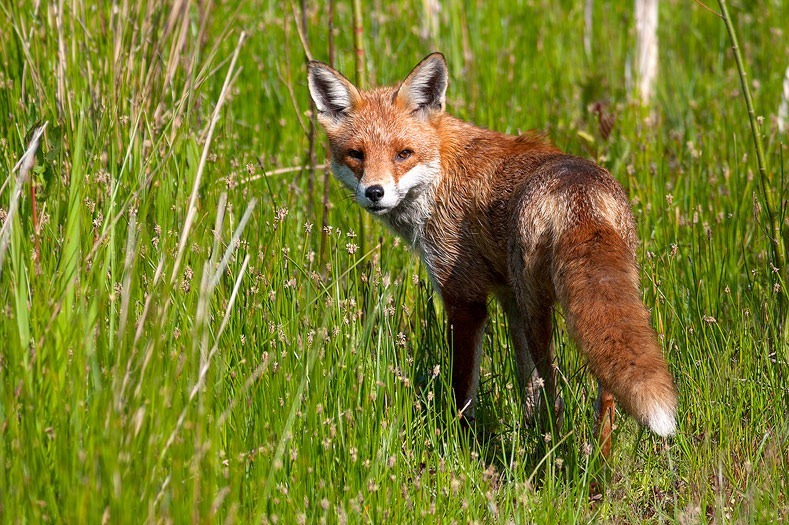
This has to be my most favourite animal to both photograph and watch, but for years barely got a glimpse of one. Since Fox hunting was banned and my general knowledge of them improved I’ve seen them on regular occasions though not to the extent where I can go onto location and plan to photography them with some certainty of success such I can with Roe Deer.  The picture below is one of my favourites as it shows it in perfect condition and it was in perfect conditions for taking the photograph – bright sunny weather that helped show the reddish brown coat against the green grass and enabled me to stop my lens down to get a greater depth of field so keeping the Fox in focus from head to tail.  There is also the direct eye contact.

I think I could spend all my time just taking photographs of these entertaining animals.  I would love to be as good as someone like  Walter Barthélemi who’s images, especially of Fox cubs, are fantastic.

Fox

Rabbits

Probably not everybody's idea of an interesting subject, but last year when I spent some time watching them at their warrens. I found them very photogenic especially the the younger ones who were less cautious and playful so easier to take photographs of.  Unfortunately, this year they haven’t been so numerous and the warren that I used to visit last year is completely abandoned as were the surrounding ones, so it’s unlikely I will have much success this year. 

This picture was one of many I took last year but particularly liked it because it was different, stretching up to feed on the leaves.  It was also an example of the patience needed in wildlife photography, as I had to wait up to an hour before they would come out of their holes and except my presence.

Rabbit

Red Squirrels

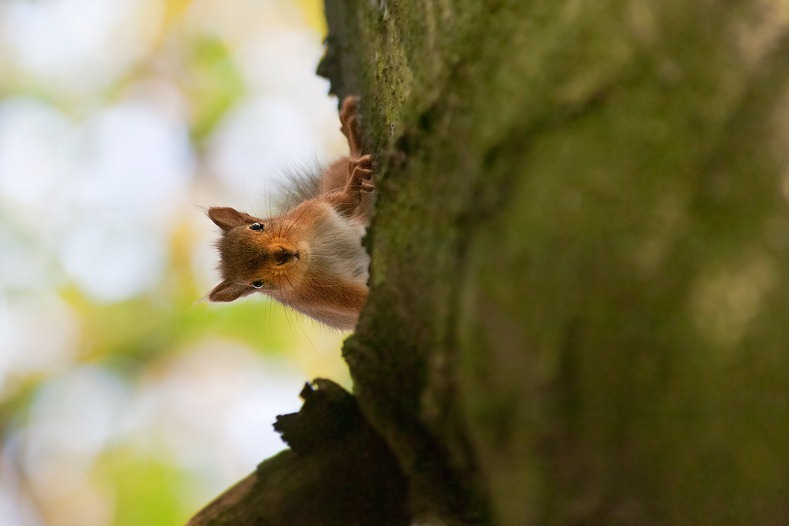
There’s something about the Red Squirrel that makes you can’t help but like them.  They seem to have a character that the Greys don’t.  Disturb them, and, unlike the Grey that will just disappear, they will stop to scold you first.  When this picture was taken, I was watching Red Squirrels from a distance, when out of nowhere I heard the typical scolding noise from just above my head – looked up to see this one peering down at me from only a few metres away!  In the last year, there has been an increase in sightings of them as they are fighting to cling onto this area due to the spread of the Grey Squirrels. It seems inevitable that they will disappear from most of the UK, so in the meantime I will make the most of any encounter I get.

Red Squirrel

Sparrowhawk

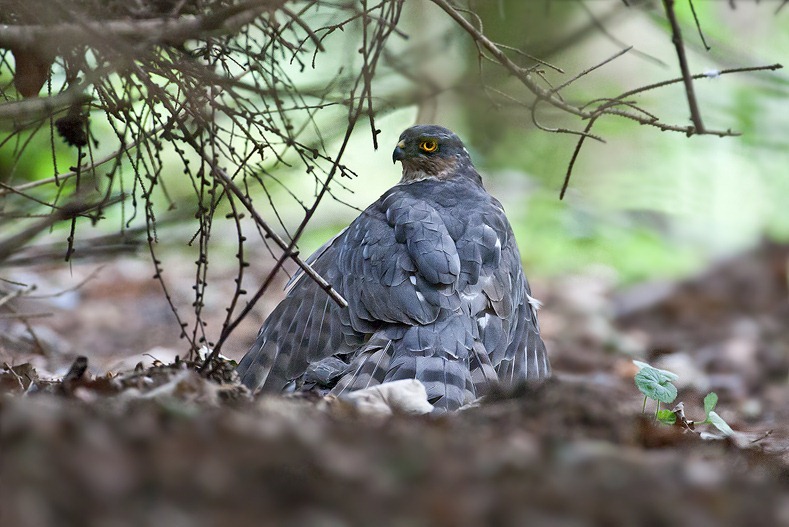
Not so much taking pictures of Sparrowhawks, as I’ve had little opportunity, nor is this photography particularly any good, but it’s about being in the right place at the right time and simply being lucky.  It was one of those close encounters with nature that may come up once every few years.  In this case I nearly trod on this elusive bird of prey, as I walked through the woods.  It was tenaciously hanging onto a pidgin it had just caught and my presence wasn’t going to scare it off.  I backed off and watched if from a distance as it finally ignored me and tucked into its meal.

SMP_2404

Kingfishers

Definitely a photogenic and colourful bird though not the easiest to get an image of. The only thing missing from this image is a fish in its beak.  I deliberately kept it off centre to follow the ‘rule of thirds’ and the reeds in the background and sunshine bring out the colour.  It was on the branch for about 5 seconds and was gone, after waiting hours to see it.  It was worth the wait.

Kingfisher

Roe Deer

For years I never saw one of these, although the most common deer in the UK, they are also very shy, feeding during the night and holding up during the day in cover.  It was a good example of learning about an animal and field craft that meant that I would regularly start seeing this deer.  It’s probably the animal I’ve photographed most in the last three years, often being able to photography them with just a 300mm lens.  If surprised they will bolt, but almost certainly stop and look back.  If they are not sure they see you, they will stop and stare at you in which case, it’s a matter of who will flinch first.

This image is an example of how simply just sitting down quietly, with your back against a tree to hide your silhouette and down wind, they will often come to you.  This one I saw, with another, walk straight towards me, getting closer and closer until it eventually saw me and even then wasn’t too sure about me.  It was my camera shutter noise that made it move away.  This image caught it just as it saw me.

Roe Deer

Grey Squirrel

More plentiful than Reds and not half as idyllic.  I like this image for its sparseness.  It was digging around in the snow, presumably for a previously buried cache of food and was poking halfway up out of the snow.  I took a dozen variations of this, but this one seemed the best.  The exposure was tricky due to all of the white.

Grey Squirrel in the snow

Short Eared Owls

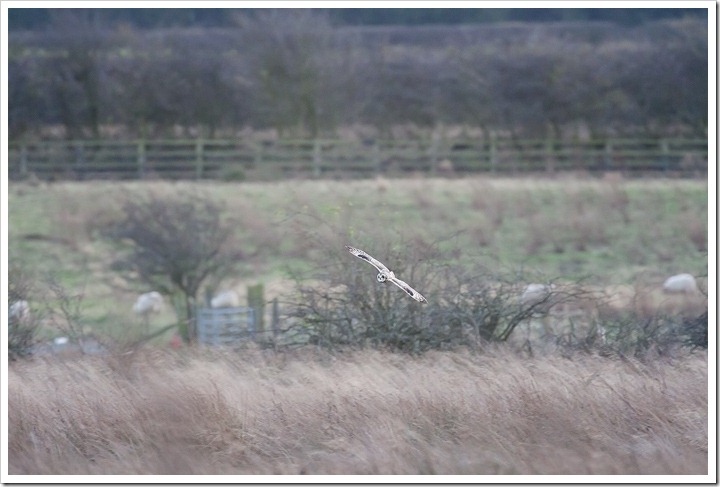
My final image isn’t particularly very good, but it is of a bird that is just so entertaining to watch.  It’s only just in the last year that I’ve really seen them, presumably due to a good year for voles.  It has an amazing facial look, with those intense eyes and it’s great just watching them hunt.  Unfortunately, it’s always been poor light and from a distance which is why I’ve had little success so far.

Short Eared Owl

Hopefully this bit of reminiscing has been a bit therapeutic and helps keeps me going until I can finally get out, although again, this weekend isn’t looking too promising weather wise.