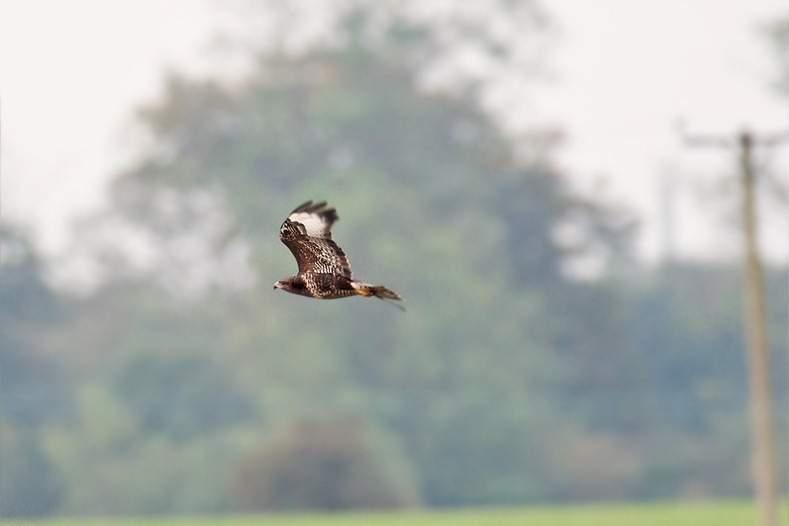
 With plans to visit and photograph the Rabbits I visited earlier on in the year, I stopped off first at Prestwick Carr having not been here since January and hearing of the re-appearance of the SEO’s, presumably migrating from the north. With plans to visit and photograph the Rabbits I visited earlier on in the year, I stopped off first at Prestwick Carr having not been here since January and hearing of the re-appearance of the SEO’s, presumably migrating from the north.When I got there early in the morning it was dull with brief periods of sun. In the distance was a perfect rainbow – a sign of the rain to come, although not forecasted. There were few people about, the advantage of getting up this early, with only the odd cyclist and walker passing by. As I made my way up bumpy track, I spotted in the distance, a Buzzard perched at the top of a tree. As I got closer it few across and made a swoop at second one atop of another tree. They then flew off together into the distance. Further in the distance I could make out a Kestrel being mobbed by a couple of Magpies and another hovering over some fields. Jets from the nearby Newcastle Airport were regularly taking off presumably with people going to sunnier climes and I couldn’t help wishing I was one of them.  |
 |
 |
 |
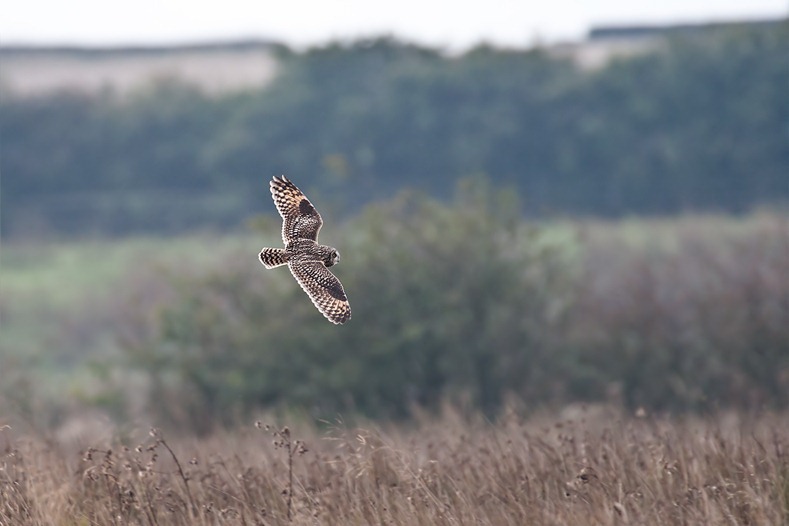
| As I watched the Buzzards disappear into the distance, my attention was attracted to movement in a nearby overgrown field where I could see the occasional head of a Roe Deer bob into sight. Suddenly, three Short Eared Owls came out of the long grass, obviously disturbed by the Deer. In the poor light and with a converter attached to my camera, I was struggling to get a focus lock on them so had to switch to manual, by which time the owls had started landing back down again. I managed to get one half decent distant shot before all but one disappeared as quickly as they had showed up. |
 I was annoyed about missing such a rare photo opportunity before realising that I wouldn’t have even known they were there had it not been the chance of the Roe Deer passing through and spooking them. I waited a further hour hoping they might make another appearance, knowing that they are normally daylight hunters though these particular ones seemed to prefer dusk. In the meantime I was entertained by a Wren fluttering in and around the long grass nearby and some ponies playing in the distance. Eventually, with dark clouds approaching, I headed back down the track. I had spotted five Buzzards and four Kestrels though some of these may have been the same ones, and the three SEO’s. I was annoyed about missing such a rare photo opportunity before realising that I wouldn’t have even known they were there had it not been the chance of the Roe Deer passing through and spooking them. I waited a further hour hoping they might make another appearance, knowing that they are normally daylight hunters though these particular ones seemed to prefer dusk. In the meantime I was entertained by a Wren fluttering in and around the long grass nearby and some ponies playing in the distance. Eventually, with dark clouds approaching, I headed back down the track. I had spotted five Buzzards and four Kestrels though some of these may have been the same ones, and the three SEO’s. |
 |
 |
 |
 |
| I arrived at my next location in a light rain (not forecast) and settled near one of my favourite locations at a Rabbits warren. After about twenty minutes the enviable happened as a dog walker went right by me. Where I was, was off the beaten path and this person must have seen me and what I was doing well in advance but chose to walk right past anyway, dog off on a rampage. Soon after a family with about four dogs came nearby, again dogs let on the loose. This is area is supposed to be a Nature Reserve. Obviously my idea of what a Nature Reserve is and what the Councils idea of one, are two different things. I would have thought it was somewhere where nature is protected and people can sit and watch wildlife and enjoy the surroundings rather than some dog super highway. Since coming here I have seen dogs chase rabbits, birds on the small lake, a fox, other dogs and have even had them have a go at me. You need a dog to walk around here during the day to protect you from other dogs! Anyway, rant over, clearly I had no chance at this late time of the day (10 am), so I started my way home taking some sanctuary and seclusion hopefully by going through a more remote part of the woods. After an uneventful stroll and with the rain now thankfully abated, I came across the sight below – obvious a Sparrowhawk kill but didn’t think much of it as they are quite a common sight in most of the woods in the area. |
 |
| A further three metres along, I saw a grey flash of movement in and around the undergrowth at the other side of a tree I was about to walk past and so stopped still. At first I thought it was a Grey Squirrel, then quickly saw it was a bird with its wings out so I thought it was an injured Pigeon. As I looked more closely, I could see, from only about a metre away, two yellow piercing eyes looking up at me and realised it must be the Sparrowhawk with the kill from the feathers I’d just come across. The female Sparrowhawk was a typical ‘shielding’ of its prey from other, would be predators and the way she was looking at me, she must have included me in that! I know from experience that Sparrowhawks kill ratio is not particularly high, having seen plenty of attempts but only one success before so I didn’t want to scare it from its prey so very slowly walked back, expecting the bird to take flight. Amazingly, this plucky bird stood its ground – considering I nearly trod on it it wasn’t going to give way. I got to some distance then laid down to make myself look less threatening to it and carefully took my camera out, still expecting it to make off with its newly acquired food. |
 |
 |
| I managed to get a couple of images off in the difficult, dark light before it inconveniently pulled its prize underneath some undergrowth and just waited looking around. Eventually it felt happy enough to start tucking into the Pigeon there and then. I was surprised as I have seen female Sparrowhawks, who are large enough, take Pigeons off into the the trees with them to feed. It took about twenty minutes to devour its meal, regularly looking around with those bright yellow eyes, no longer interested in me as I only got the occasional glancing look. When finished it flew off and disappeared into the trees. I wonder what the chances of my stumbling across such and event never mind watching it until the end. I certainly made up for previous disappointment especially considering this time there were no dogs around. |
 |
| Brief video showing the Sparrowhawk feeding. |
Sunday, 25 September 2011

Sunday, 18 September 2011
A few small woodland birds
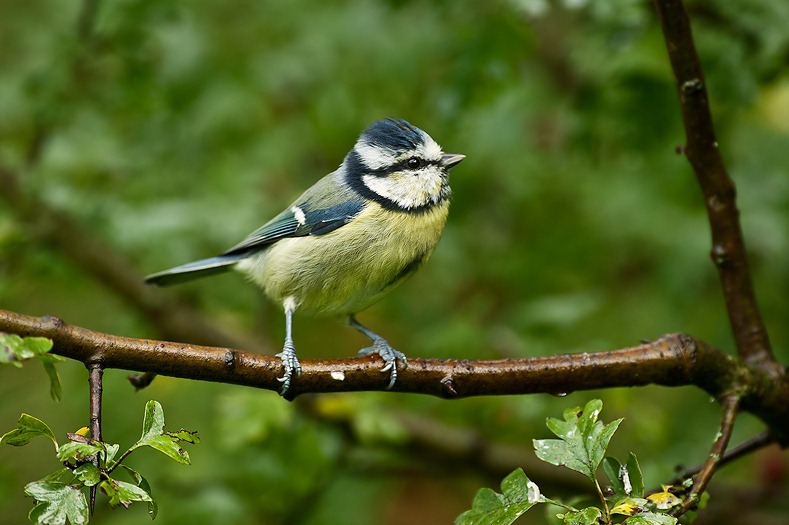
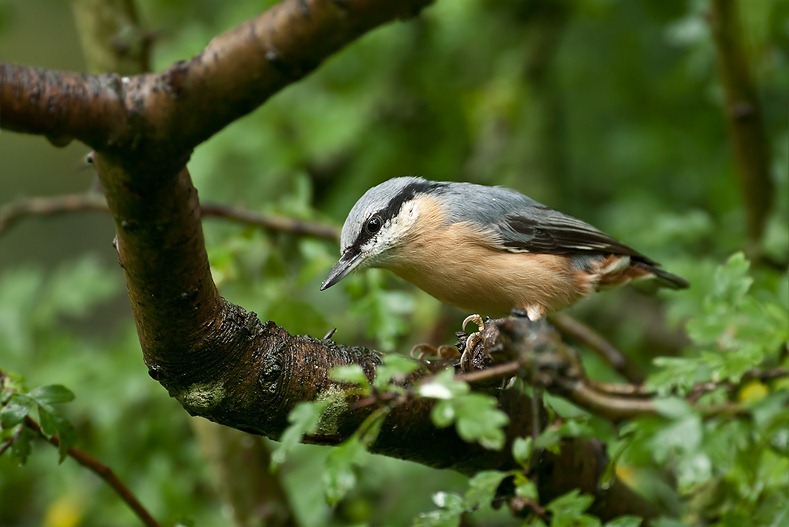
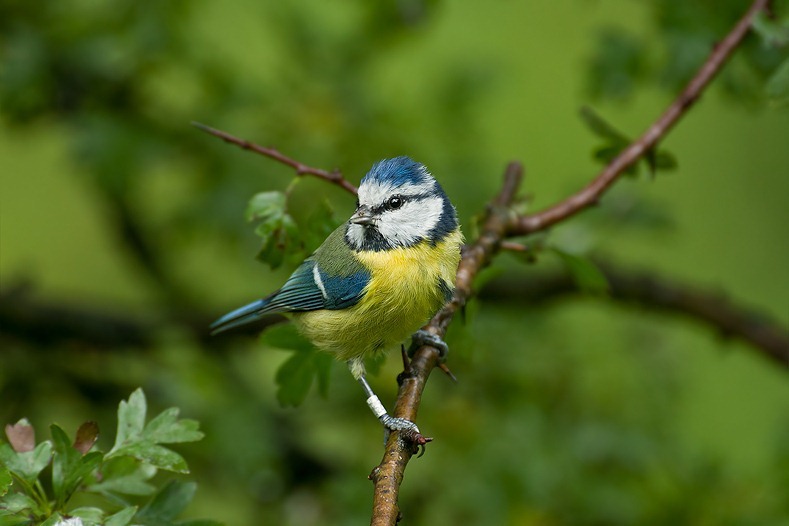
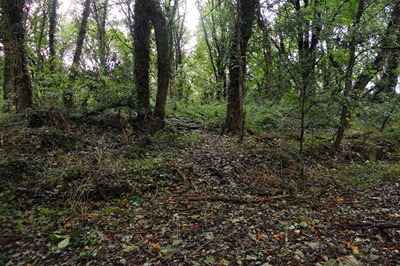 Despite yet another dark and dingy weekend morning, I was surprisingly motivated to get up and go out. Although it was raining when I first left it soon stopped though remained dull and overcast making, as with last week, photography difficult but at least the wind wasn’t as bad. Most of the photographs taken I deleted on the spot, mostly through blurred movement as they wouldn’t stay in any one spot for more than a few seconds though, with at best only a 1/300th of a second shutter speed, I was lucky to get as many as I did especially combined with the limited depth of field. |
 |
 |
 |
| | It was a couple of hours into the morning when all of a sudden the birds made a commotion and fled and I just managed to see a flash of grey come streaking through the trees and land some distance away. I could see through the branches that it was a male Sparrowhawk. I think it must of aborted at the last minute changing direction from its intended prey and seemed to be looking back in disgust. Although it then flew out of sight I was sure it was still around as I could hear mobbing Magpies and the birds I was photographing took a long time to pluck up the courage to return. I’ve only ever once managed to witness a Sparrowhawk make a successful kill and that was a pigeon. |

 |
 |
 |
 |
 |
 |
 |
Sunday, 11 September 2011
A Slow summers end
| I’ve been going through a distinct purple patch when it comes to my photography in the last few months, not helped by the worse summer apparently, in 18 years. It’s not that it’s just been cooler and we’ve seen less sun than a ‘usual’ summer, but it’s also been winder and completely unpredictable, and by some freak of chance, the weekends this year seem to almost be guaranteed to be worse than the weekdays weather wise! Combining this with few successes when I have gone out, my moral has been at a low ebb, it’s like nature herself has just shutdown for a while. I did think of leaving the blog until I had some real success – only two of the last five outings has even resulted in my taking any photographs – but that could be another month at this rate, so I’m posting ‘the best’ of the last six weeks or so. |
 A rare summers day |
 |
 |
| Most of the typical days (if dry) have looked like the image below – flat and grey but also very windy, making photography more difficult as, from a technical point of few, I’ve had to up the ISO (typically 1600 – 6400) had slow shutter speeds and wide open apertures. You can see the narrow depth of field this has created with some of the bird images below with barely the head in focus. The lack of decent light has made the images look very flat and dull. |
 |
 |
 |
 |
 |
 |
 |
 |
 |
 |
| I may just work on my landscape photography for a while until I get my ‘mojo’ back. Already the leaves are changing colour and although 30-40 mph winds aren’t good, grey skies can actually work in your favour and at this time of year with the mornings getting darker, you don’t have to get up so early to catch the golden hour and yet it is still reasonably mild. |
Tuesday, 2 August 2011
Marsden Rock to Trow Quarry
| The last month has been one of those periods where, for one reason or another, I have had no luck in seeing, never mind photographing anything. Considering the time of year you would think the countryside would be brimming with life. With this in mind I decided on Sunday to go to the coast where I new there would still have various seabirds – Gulls, Fulmars, etc., and I could practice some more birds in flight techniques and this would help alleviate my photography withdrawal symptoms. Armed with the Canon Mk III and Sigma 500mm f4.5 I decided, since it was a nice day, to start off at Marsden Rock and walk along the beach and cliffs to Trow Quarry South Shields. |
 |
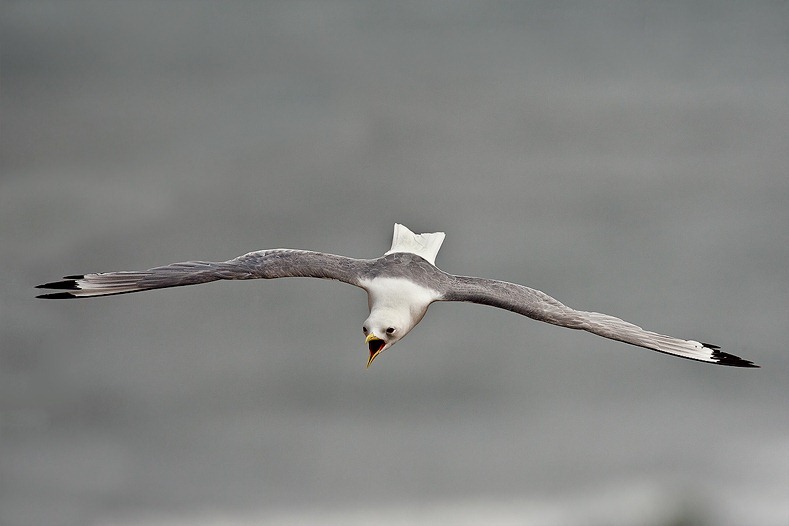
| Marsden Rock and the nearby cliffs, I think are a much underrated area for wildlife, in this case seabirds. It may not have the more exotic birds such as Puffins or Guillemots you get on the Farne Islands but it was a close comparison when it came to the shear amount of noise that many nesting birds make. A set of steps going down from the top of the cliffs to the beach made an ideal location halfway down to photography the gulls in flight which clearly showed a pattern to their flight enabling me to roughly guess the best shots, though it still tested the cameras auto focus abilities (not to mention my arms strength). |
 |
 |
 |
 |
 |
Above Marsden Rock looking north – below part of the Nesting cliff face |
 |
 |
Some (above) were able to sleep despite the noisy neighbours (below) |
 |
| After filling up two cards with images and not pushing my luck by staying underneath the cliffs, which were basically a very large bird toilet, I decided to start the walk north, along the shoreline where a lot of the juvenile birds had collected and were feeding and squabbling amongst each other |
 |
 |
 |
 |
 |
| With another card filled up I continued my journey where my attention was quickly taken to some noise above me. As I looked up I saw half a dozen small birds ‘chasing after’ a Kestrel which flew to the end of the beach and joined another one hovering over the cliff edges. Too far away to get any kind of decent photograph, I quickened my pace in the hope they may still be around by the time I reached that point. By the time I did get to the bottom of the cliffs where they had been, one of them flew back over head (followed by a small swarm of mobbing birds again!) and the other had made its way along the cliffs in the way I had just come, just as I had got up the cliff steps to the top. Making my way back along the cliffs the Kestrel returned giving me and a number of gathering onlookers a great sight of it majestically hovering into the wind and then occasionally diving into the grass edge which unfortunately, was out of sight. Although I was able to take some photos of it rising up again and pass something from its talons to its mouth, I couldn’t see what it was, but to eat it on the wing it must have been smaller than a rodent. It wasn’t until I got home and checked the images that I realised that, although I had compensated for the exposure so as not to get a silhouette, I hadn’t given it a faster shutter speed. (Too engrossed in watching this spectacle) The third image below of the Kestrel hovering was shot with a 500mm lens plus converter at a shutter speed of 1/640 so I was lucky that I managed so many in focus as the actual focal length was 700mm, hand holding the lens and a strong breeze. The normal rule is to have a shutter speed faster than the focal length. Because it was relatively still whilst hovering these were ok whereas those of it diving and rising were blurred to some degree, still I was happy with the results and to be so close to such a display. |
 |
 |
 |
 |
Above - Looking back at me and below a rear end view, talons at the ready |
 |
 |
 |
| After the Kestrel moved off, I continued my last leg of the trip, to finish up at Trow Quarry. Every time I have visited this place, I have hoped to see the ‘resident’ Little Owl. After another, none to optimistic search, I finally spotted the diminutive owl perched on a rock edge starring right back at me watching it through my binoculars. Unfortunately, it wasn’t as pleased to see me as I was it, as it bolted into crevice before I had a chance to even think of photographing it. At least I had finally seen it and, I figured, since it went into a ‘hidey hole’ rather than fly away, that location was probably where it lived and so now I know where where to look, a more stealthy approach next time might produce a photo opportunity. All in all the day produced a boost to my much needed for wildlife and photographic success. Just as a side note for anyone interested in the photographic side, particularly the Sigma 500mm lens, the whole walking trip including stopping to take all the photos, I was carrying and hand holding the lens – a total of around five hours. |
Subscribe to:
Posts (Atom)


