Showing posts with label Winter. Show all posts

Monday, 5 March 2018

Beast from the East comes to the North East

They named it ‘The Beast from the East’, the cold and snowy weather that hit the country last week.  Most people seemed content with staying in out of the cold but it was too good a photo opportunity to miss for me at the weekend, so I dug out my thermals, covered myself from head to foot in layers and went out to see what I could find.

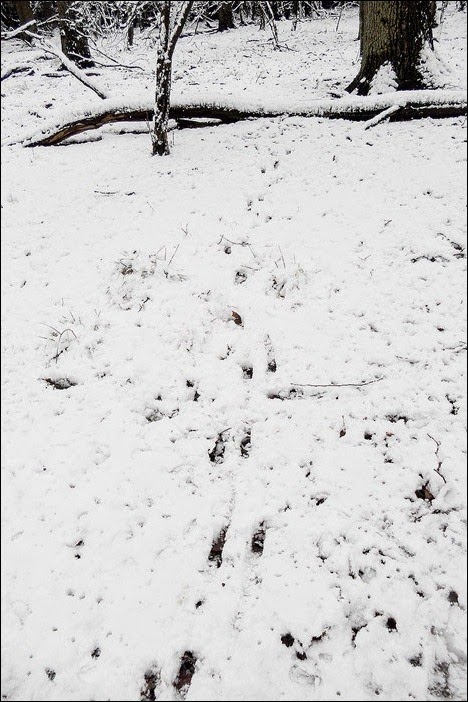
One very good reason for going out is to find out what wildlife is around by checking the various foot prints and trails in the woodland.  The woods themselves were very quiet as if everything was trying to keep warm and under cover but it was immediately obvious from the tracks just how alive the woods were – at least nocturnally.

Click to enlarge

Everywhere there were Rod Deer tracks despite after 40 minutes and still early in the morning, I hadn’t actually seen one.  The above panoramic shows Roe Deer tracks in every direction.  Fox tracks were also prominent though not in the same numbers.  Probably one or two active Foxes.  I followed one set of recent tracks which in turn followed the trail, occasionally going off but soon returning but eventually leading off into the underbrush.  It was clear these were made in the last few hours as I new there had been a light dusting of snow early that morning which could be clearly seen within the imprints (see below).

I was surprised to see how many Rabbit tracks there were as I rarely see them here, but here they were very clearly around the woodlands. 

However, actually seeing anything other than for some birds which seemed to be far more ‘tame and approachable’ than usual, remained elusive.  Two brief sightings of a Roe Deer and that was it. 

I decided to sit down in a spot I have had previous success with seeing Roe and Foxes and started to set up my camera and lens on my Gimbal head and tripod when, snap, one of the legs broke at the joint.  I don’t know if the cold contributed to the demise of my trusty tripod but after what must be 10 years of great service, it is no more.  I would have been better to have happened at the end of my day than at the beginning as now I didn’t have any real support other than resorting to using my bag or knees whilst sitting low down.

After realising the autofocus wasn’t functioning on my Sigma 500mm lens, I checked the settings and everything seemed fine.  Batteries at full charge, etc.  I tried changing to a different lens – that worked so it was the big lens that was now not working.   So know with no support and only manual focusing available and still only around 9.00am, I was tempted just to give up, feeling just a little fed up, but I continued though I knew there would be little point in keeping the 500mm lens attached whilst walking because I know if an opportunity came about, I wouldn’t be able to hand hold it so changed to a 18-135mm lens.

I wasn’t really expecting to see anything at this point anyway and just thought I might be able to get some ‘winter woodland shots’, but despite the obvious beauty of my surroundings, I just couldn’t get any kind of composition.  As I continued on my way I glanced to my left and saw a Roe Deer close by just standing looking at me.  I expected it to shoot off so turned my back on it whilst I set my lens to 135mm just in case.  To my surprise when I turned around again, it was still there though had started to walk away.  I put my camera to my eye and took a couple of images and noticed there was another couple of Roe resting which had now popped their heads up.

They didn’t seem to bothered by my presence but did start to get up to move away.  I didn’t want to push my luck and decided not to alarm them any further and move off myself.  It’s good to remember that in cold weather like this, wildlife are always on the brink of surviving and having to use up precious energy to run away will not do them any good.

I spent the rest of the day visiting a number of locations and managed a few more photographs, though nothing special.  You really appreciate auto focus when you don’t have it.  Birds can be very twitchy and don’t stay long in one spot and Grey Squirrels are constantly on the move, so there was a lot of ‘hit and miss’ with what I did take.

At one point I decided to take a landscape picture just using my phone when that suddenly died on me!  It was really starting to look like it was not going be my day.  Luckily it turned out the cold had just drained the battery but I had a battery pack on it so charged it up again.  Still, 90% had drained in three hours of being out in the cold.

The good news (I think) is that it was the cold that seemed to have caused the auto focus to fail.  On my return it started to work again and with a little research found that the cold could cause this.  I’m not completely convinced that it isn’t a sign of some other problem waiting in the wings as I have taken this lens out in sub zero temperatures before without issue.  The difference then is that I had a 1D series body attached which research also suggested the power of the camera body could make a difference.

I guess only time will tell if it was just the cold or there is another problem lurking, waiting to happen again.  Meanwhile a new tripod is winging its way to me.


Tuesday, 1 March 2016

Sand, Sea and Cold Wet Feet

I’ve spent much of the winter months (weather permitting) working on my seascapes.  At this time of year getting up to photograph a sunrise isn’t too painful – currently sunrise is around 7:00 am.  Allowing for travel and setting up at about 30 minutes before the sun rises, that means getting up in the morning at around 5:00 am at the latest.  Still manageable.  With the mornings becoming lighter by the day, soon it will be a struggle so I’m making the most of the opportunity.  Of course, I do have a bit of a thing about watching the dawning of a new day over the sea.  It never gets tired for me especially when it’s quiet and nobody is about.
 
This weekend it nearly didn’t happen.  The forecast was for low cloud and possible snow but I was going to go out regardless but since I wasn’t going to see the sun I figured I could get there a bit later.  The overcast sky would still produce the kind of subdued lighting suitable for photography.  As it turned out on the morning, I woke up over an hour before my alarm was due to go off so I checked the latest forecast which had now changed to light cloud and so a possible sight of the sun.  This was motivation enough as these might be the last ‘ideal’ conditions, with the tide going out and at just the right time for sunrise. 
 

IMG_6941-2

The first image is quite blue temptation and the first thought might be to ‘warm it up’ in post processing, but it is as I remember it, though maybe darker as it was about 20 minutes before the sun rose.  As the tide went out I moved along the beach where rocks were starting to reveal themselves, making for a more interesting foreground.  Anyone who has ever taken images of seascapes will know there are a few good reasons for doing so when the tide is going out, one of which are the waves themselves.  If the tide is coming in the waves are more forceful and you risk, literally, getting washed away.  With the tide going out the waves are more gentler, however every now and then a big wave will still come in and by positioning yourself a little distance from the tide line, this is the wave you photograph crashing over the rocks.

Unfortunately, on this morning's adventure, these ‘big waves’ seemed bigger than normal and it wasn’t long before I got my feet completely wet.  I couldn’t leave my camera on the tripod when one of these waves came in for fear it washing it away.  If I took my tripod and camera away then I would have missed the ideal shot (though still did this a few times).  The next two shots below I definitely got my feet wet!  Although initially I did try and move out of the way of one of these waves whilst keeping within grabbing distance of my camera, it didn’t ultimately make any difference and in the end I didn’t bother at all to get out of the way, though not before on one occasion when, surprised by one large wave I instinctively reacted, the weight of my camera back caused me to fall backwards into the wave, where I let off a stream of obscenities, not realising there were a couple of people nearby, beachcombing.

IMG_6971

IMG_6987
Despite my feet, legs up to my knees and now, back, were completely soaked and in temperatures around freezing, I persevered.  As sunrise was now due it was clear I was unlikely to have any kind of glowing spectacle as I could only see a slight orange horizon but the cloud formations were a spectacle in themselves and it wasn’t until I got home and could look at some of the images more closely that I could see in the distance some rain storms over the sea. Unfortunately these image, due to their size don’t do justice to scene and it’s best to look at a better sized image here where you can see the storms in the distance.

IMG_7025

IMG_7045-2

IMG_7072-2

IMG_7123-2

After a dozern freezing drenchings later and with the light becoming too bright and harsh I decided to call it a day.  Some attempt was made to dry my feet out.  When I took my boots off I could poor the water out!  Luckily I carry around a small hand towel in my camera bag, just in case so was able to dry my feet off.  Next time though I will remember to bring a spare set of socks.

1

Saturday, 23 February 2013

Spring?… Well, not quite!

Beginning of the Week

A rare bout of wall to wall sunshine brought me out of the doldrums to see what wildlife was on offer.  An opportunity to photograph two birds in particular that have eluded my previous attempts – the Bullfinch and and the particularly pretty Long Tailed Tit – were too much to pass up.  The former seems to nowadays be rarer than I remember them to be during my childhood, where they seemed to be quite common.  The latter just seems to always stay hidden away. 

The bright, almost spring like sunshine helped bring the best out of the images with a fast shutter speed enabling me to ‘freeze’ them as they didn’t stay in any one spot for more than a second and I resorted to pre focusing on one spot where they would stop briefly.

SMP_9018
 
SMP_8874
 
SMP_8880
 
SMP_8909
 
SMP_8918
 
SMP_8927
 
SMP_8932
 
SMP_8966
 
SMP_8991
 
SMP_8996
 
SMP_9011

End of the Week

Within a week, winter had returned with a fall of snow blanketing Tyneside. Still, I can’t resist the temptation in going out in this kind of weather.

SMP_9029
 
SMP_9033
 
SMP_9042
 
SMP_9051
 
SMP_9088
 
SMP_9108
 
SMP_9167
 

SMP_9044

A post of mine wouldn’t be complete without some kind of rant at dog walkers.  A sign at the entrance of this nature reserve saying ‘dogs to be kept on lead’.  Of the dozen plus dog walkers I saw, only one had bothered to adhere to this rule.  kudos to that one individual. (not the individual in the picture who had just walked past that sign!)

Thursday, 17 January 2013

Snow, Muddy and Murky

A new fall of snow for me is not just a good photogenic opportunity, but an ideal chance to see what is out and about by the tracks left behind.  With a fresh covering of snow, I went out earlier this week in the hope to check on what mammal wildlife was around in the local area, specifically Foxes which seem to have been more elusive in the last few years.  The forecast was for a temperature of around around minus one, very little wind, mostly overcast and maybe a flurry of snow later on so it was ideal.

Since arriving on location mid morning I wasn’t particularly expecting to see any mammals but it wasn’t long until I did find the main tracks I was after – Foxes.  They were slightly covered up suggesting they had been made very early morning as there had been a lot of snow the night before and another light fall early morning.  They followed a typical path showing two foxes, perhaps together though one track went off in another direction further up the trail.

I had hoped to use what I found to find out better their movements and maybe a den but the tracks showed me what I already new about their route but at least I new they were still active.  Unfortunately, due to a combination of the muddy conditions and the second covering of snow it was hard to follow the Foxes tracks as they tended to use the same pathways as people, which were churned up due to the last few months of heavy rain.

DSCN0423

I walked around for a while until deciding to go to one of my favourite vantage points when photographing Roe Deer in the off chance that there may still be some knocking around this late and so photographing one in this idyllic surrounding.  Just before I got there, three Roe’s went by the opening in the woods where my camera lens would have been pointing a minute later had I arrived earlier or them later!

After waiting thirty minutes or so encase of any further sightings, I then walked around for an hour when it started to snow – heavily!  What an image I could get if only I could see and photograph a deer in this.  They and the rest of the wildlife probably had more sense as the only living creatures around were some Mallards on the lake, seemingly indifferent to the conditions and, like me, had a covering on snow.

SMP_7324
SMP_7329
SMP_7331
SMP_7334
SMP_7345

Despite the conditions, I still carried my camera and lens around rather than putting back in my bag just in case ‘that’ opportunity arose.  This, however this put this equipment to the test as it became covered in snow.  The camera shouldn’t have had any problems being weather resistant, but my lens only had it camouflaged covering for protection so I draped my netting around it too.  The problem seemed more about getting any snow on the front element which, as shown during my previous outing, can ruin a shot. 

The Sigma does come with a soft lens cap but this is only really useful once the lens has been packed away.  It doesn’t fit properly when the lens hood is on and it would easily fall off.  Amazingly, I can’t find a single place in this country that makes alternative lens caps for this lens though I have heard of people making their own out of food containers which I might try as I can’t rely on the lens hoods depth alone for protection.

As quickly as the snow started it ended, leaving the landscape with a fresh coat of snow, covering up any of the tracks I had hoped to find but I decided to continue having a walk around. 

DSCN0426
DSCN0433
DSCN0435
SMP_7352
SMP_7402

DSCN0436The few tracks I found during the rest of the day were, for the most part, covered up by the latest snow or were being eroded due to the snow melting in the trees causing clumps of snow and ice falling onto the snow.

DSCN0431

Although you can barely see them the tracks above look like Rabbit ones and, in this area, they are nocturnal as I have very rarely seen them during the day.  It might explain why the Foxes are also nocturnal being their main source of food.  You can also see from the image above where the melting snow has fallen from the trees making it even more difficult to see any tracks.

I did come across one other set of tracks which were those of a single Roe Deer and obviously made during the last hour as well as some older ones barely recognisable now.

The tracks of both Rabbits and Roe Deer are very recognisable and in the case of the latter, easily found during the rest of the year too.  Like the Fox they tend to often use the same paths as people do so are easily found in mud and soil.  However, I have never felt sure of my ability to tell the difference between Fox tracks and those of a dog despite having done numerous research.

Much of the advice given to recognising the differences I’ve found don’t always apply in reality.  Using one example found at http://www.skullsite.co.uk/prints/Fox/fox.htm isn’t always clear cut.

Below I’ve superimposed a dogs print next to a Foxes, reducing its size to match.  Putting aside the dogs print being a clearer one, much of the differences don’t seem to apply here – that is, if you draw a straight line across the top two the rear toes they wont cut across the front toes.  Or you can draw a cross in the centre of a Foxes footprint and it also wont cross any toes.  Finally, the back pad is more of ‘jellybean’ shape.

DSCN0421

Admittedly, the above Foxes print isn’t the clearest so not the best of examples to use.  I use a different type of logic when it come to identifying the differences such as the one above.  I knew it was made at a time when a dog was unlikely to be around.  The prints were by themselves – no human foot  prints so it wasn’t a dog walker.  Finally, Foxes tend to have a specific route often traveling with a purpose.  Dogs don’t usually follow a straight, regular line.

The only other way of guessing is using the popular guides and if the gaps between the pads are quite spaced out, then it’s more likely to be a Fox, they are also usually smaller and consistent size and narrower though this could depend on the dog as a dog the same size and shape as a Fox will, presumably, give a similar print.  It must take a very skilled individual to be confident in being sure of the differences between the two. 

I spent the rest of the day walking around and making the most of the plentiful supply of songbirds around for photo opportunities before eventually leaving as the sun started to go down.

SMP_7380
SMP_7410
SMP_7448
SMP_7449
SMP_7467

With the regular mention of my photographic equipment, I thought maybe it was time to say a word about my trusty boots.  Despite spending over five hours walking through snow and wading through mud and water with the occasional ankle deep drenching, my feet remained warm and dry and it wasn’t until one too many dunking at the very end that a slight dampness was felt.  When I brought these man made lightweight fabric boots to replace my heavier leather ones, I didn’t think they would last long but they are still going strong and I’ve been very impressed with them.

DSCN0429